



How Leading FIBC Manufacturers Ensure Global-Grade Packaging Standards
Every year, improper bulk packaging causes billions of dollars in cargo loss, product contamination, and compliance failures across global supply chains. A torn seam, an inadequate safety rating, or the wrong liner specification can result in rejected shipments, regulatory penalties, and serious reputational damage. FIBC Bags, commonly called jumbo bags or bulk bags, are large polypropylene containers designed to store and transport powdered, granulated, or dry bulk materials. Their applications span agriculture, pharmaceuticals, chemicals, construction, and mining. As cross-border trade intensifies, the role of a certified FIBC Bags Manufacturer has never been more critical.
Procurement managers and supply chain leaders are no longer just sourcing bags. They are sourcing reliability. This means choosing FIBC Bulk Bag Manufacturers who adhere to internationally recognised standards, invest in material engineering, and customise solutions for specific industry requirements.
The Importance of Global Packaging Standards
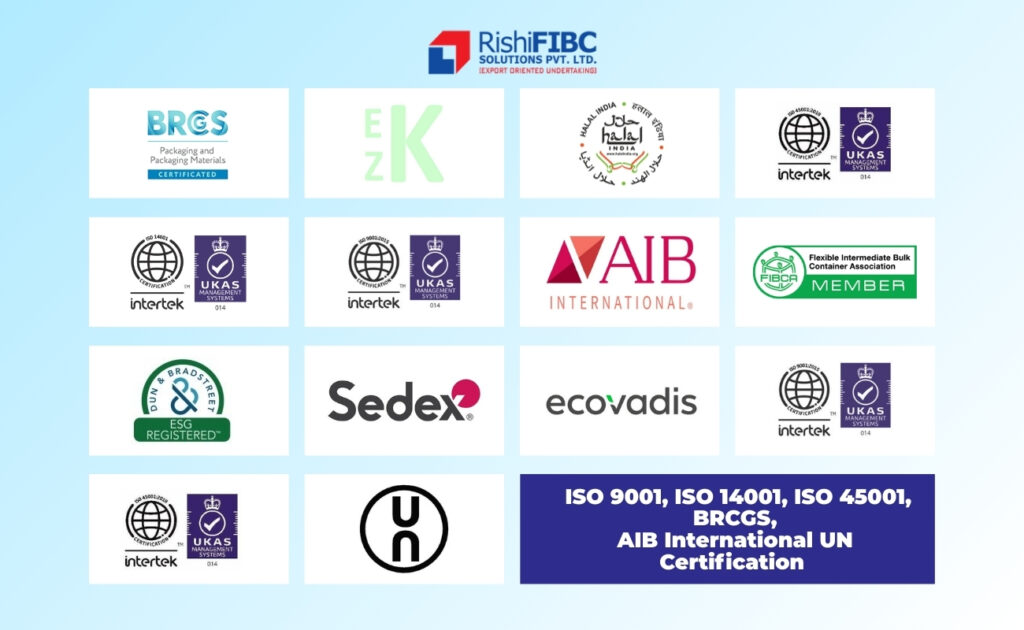
Packaging standards are not formalities. They are risk-management frameworks that protect product integrity, worker safety, and supply-chain continuity. For FIBC Bags, compliance spans multiple international systems:
-
- ISO 9001 sets the baseline for quality management across the manufacturing process. It ensures consistency in production, documentation, and continuous improvement.
- ISO 14001 provides the framework for environmental management, helping manufacturers identify, control, and reduce their environmental impact across operations and supply chains.
- ISO 45001 addresses occupational health and safety management, ensuring that workplace hazards are systematically identified and mitigated to protect workers throughout the manufacturing process.
- BRCGS Packaging Materials certification validates that packaging manufacturers meet rigorous global standards for product safety, quality, and operational controls, a key credential for buyers across food, beverage, and consumer goods sectors.
- UN Certification is mandatory for bags used to transport hazardous materials. UN-certified FIBC Bags must pass rigorous drop, top lift, and stacking tests before approval.
- AIB International audits assess food safety systems and hygiene in manufacturing facilities, adding another layer of credibility for food-sector buyers.
Buyers sourcing from a FIBC Bags Manufacturer without verified certifications expose themselves to significant legal, financial, and operational risks. Certified manufacturers, by contrast, offer documented proof of consistent quality at every production stage.
Material Quality and Fabric Engineering
The strength of an FIBC Bag begins with the raw material. Leading Jumbo Bags Manufacturers in India source high-grade virgin polypropylene (PP) as the primary fabric component. This material offers an excellent balance of tensile strength, flexibility, and resistance to environmental stress.
Key aspects of material engineering include:
-
- UV stabilisation: Bags used in outdoor storage or direct sunlight require UV-stabilised fabric to prevent degradation of tensile strength over time.
- Fabric weave density and weight: Controlled during the circular loom weaving process, fabric GSM (grams per square metre) directly determines load-bearing capacity.
- Laminated versus non-laminated fabric: Laminated fabric offers enhanced moisture resistance, making it suitable for hygroscopic or moisture-sensitive products.
- Liner compatibility: Inner LDPE liners are integrated for products requiring additional protection from moisture, contamination, or chemical interaction.
Tensile strength testing is conducted on both warp and weft yarns to validate that the finished fabric meets the required load specifications. This rigorous material validation ensures that the bag performs consistently from the filling station to the end-user warehouse.
Advanced Manufacturing and Quality Control
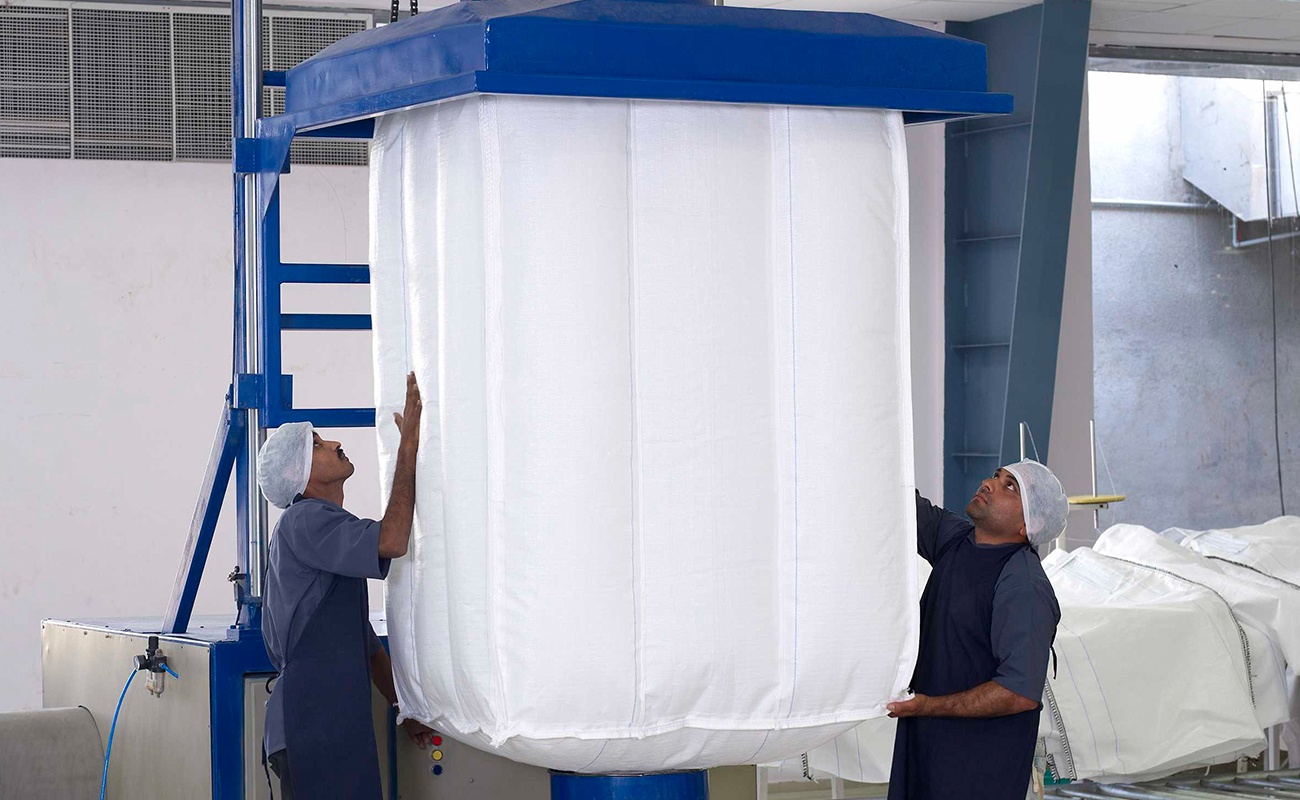
Superior raw materials alone do not guarantee a safe, reliable FIBC Bag. Manufacturing consistency is equally critical. Top FIBC Bulk Bag Manufacturers invest in automated production infrastructure and structured quality protocols to eliminate variability at every stage.
Key manufacturing quality factors include:
-
- Automated circular loom weaving for consistent fabric density and uniform wall strength throughout each bag.
- Clean manufacturing environments, including air-conditioned and air-controlled facilities for food-grade and pharma-grade production runs.
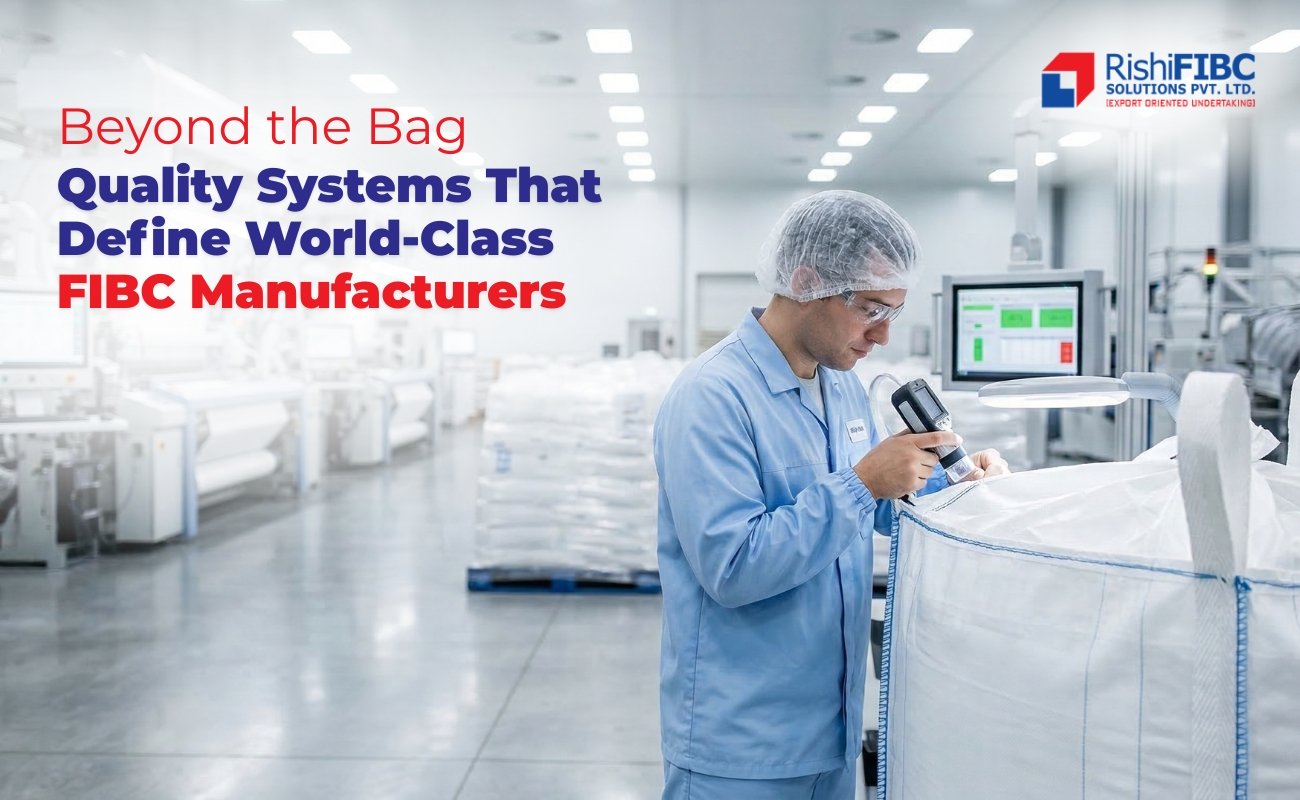
- Batch-level testing where samples from every production batch undergo load testing, seam strength verification, and drop testing.
- Safety factor verification to confirm that each bag meets either the 5:1 ratio (single-use bags) or 6:1 ratio (multi-use and UN-certified bags) as per FIBC international guidelines.
- In-house laboratories equipped to conduct full physical and safety testing without reliance on third-party facilities, ensuring faster turnaround and tighter control.
These systems collectively reduce the risk of failure during transit, improving cargo safety and reducing insurance and freight claims for buyers.
Customisation for Industry-Specific Applications
No two industries have identical bulk packaging requirements. A leading FIBC Bags Manufacturer differentiates itself by offering engineered solutions tailored to specific product properties and logistics conditions.
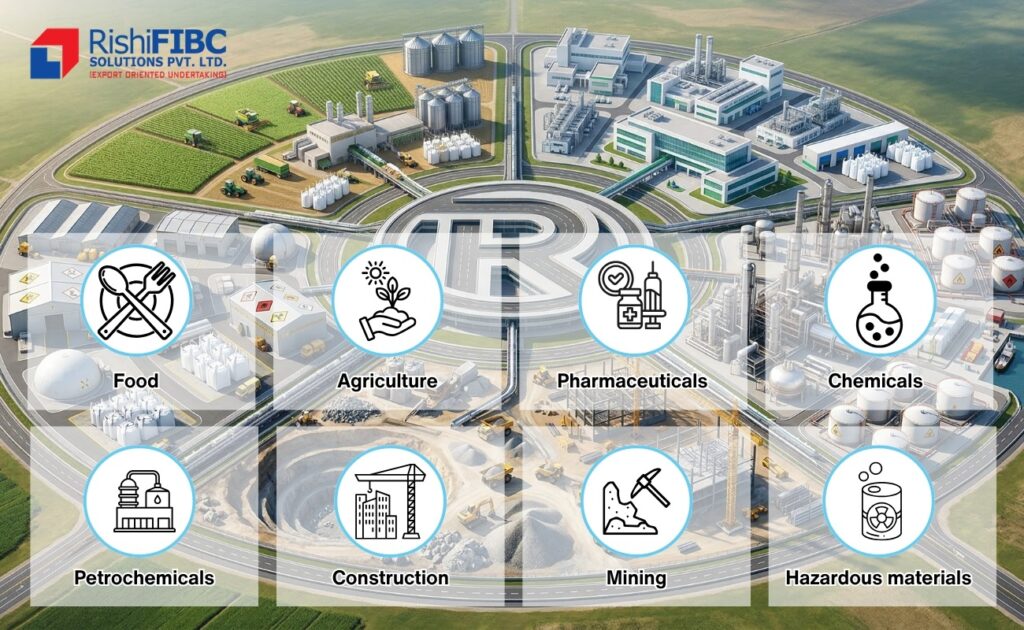
Industry-specific design variations include:
-
-
- Food and agriculture: Food Grade FIBC Bags with hygienic liners, clean-room manufacturing, and BRC-certified processes for sugar, grains, spices, and flour.
- Pharmaceuticals: Pharma Grade FIBC Bags produced under GMP conditions with full batch traceability and contamination-controlled environments
- Chemicals and petrochemicals: Type C (conductive) and Type D (dissipative) FIBC Bags for safe transport of flammable powders that generate electrostatic discharge.
- Construction and mining: Heavy-duty 4-panel and baffle (Quatro) bags designed for high-density materials such as cement, sand, gravel, and minerals.
- Hazardous materials: UN-certified FIBC Bags engineered and tested for transport of dangerous goods under international regulatory frameworks.
-
Design features such as duffle tops, spout fills, cross-corner loops, and baffled panels are selected based on compatibility with filling equipment and downstream handling requirements. This level of customisation signals manufacturing maturity and the ability to serve global clients across diverse sectors.
Why India Leads Global FIBC Production
India, particularly Gujarat, has emerged as the dominant global hub for jumbo bag manufacturing. Jumbo Bags Manufacturers in India supply markets across Europe, North America, Japan, Australia, and the Middle East, serving over 40 countries from integrated facilities.
The factors driving India’s leadership include:
-
- Vertically integrated facilities that control the full production chain from yarn extrusion to bag assembly, quality testing, and export packaging.
- Competitive manufacturing costs that allow Indian manufacturers to offer global-grade quality at commercially viable price points.
- Strategic port proximity in Gujarat, enabling efficient container dispatch to all major international shipping lanes.
- A skilled technical workforce with deep expertise in woven polypropylene manufacturing, quality systems, and export compliance.
- A regulatory environment that supports ISO, BRC, GMP, and UN compliance, making Indian manufacturers acceptable to international buyers with strict vendor qualification requirements.
The scale and sophistication of India-based FIBC manufacturing has evolved to meet the same quality benchmarks as manufacturers in Europe, while maintaining the cost efficiency that drives global sourcing decisions.
How Rishi FIBC Ensures Global Packaging Standards
Rishi FIBC Solutions Pvt. Ltd. stands among the most capable FIBC Bags Manufacturer operating from India. With integrated manufacturing plants in Gujarat and Karnataka, and an international presence spanning 40-plus countries, Rishi FIBC combines scale with precision.
Several pillars define Rishi FIBC’s approach to global-grade quality:
-
- Comprehensive certifications including ISO 9001, ISO 22000, BRC, AIB, and GMP compliance across relevant product lines.
- A diverse product range covering Food Grade, Pharma Grade, UN FIBC, Conductive, Dissipative, Baffle, Cross Corner, U Panel, and 4 Panel bag types.
- In-house quality laboratories conducting load testing, seam strength testing, and full safety factor verification for every production batch.
- Air-conditioned and controlled manufacturing environments designed to meet hygiene requirements for food and pharmaceutical-grade applications.
- Customisation capability to serve sectors including chemicals, petrochemicals, agriculture, food processing, pharmaceuticals, construction, and mining.
- A Japan-based subsidiary, Rishi FIBC Japan Co., Ltd., reflecting the brand’s acceptance in high-standard markets that demand rigorous supplier qualification.
Rishi FIBC’s integrated approach ensures that every FIBC Bag leaving its facilities meets the technical specifications, safety standards, and compliance requirements that global buyers demand. For businesses seeking a reliable manufacturing partner, exploring Rishi FIBC’s product portfolio is a practical first step.
Standards Are the Foundation of Trust
In global bulk logistics, the quality of packaging is inseparable from the quality of the product it carries. A failed FIBC Bag does not just mean lost cargo. It means regulatory scrutiny, supply chain disruption, and damaged commercial relationships.
Leading FIBC Bags Manufacturer understand this responsibility. They invest in certified raw materials, controlled manufacturing environments, rigorous testing protocols, and industry-specific customisation to ensure that every bag performs as promised, from the filling station to the final delivery point.
For procurement managers, exporters, and logistics professionals evaluating bulk packaging partners, the selection criteria should extend well beyond price per unit. Certifications, manufacturing infrastructure, product range, and export track record are equally important indicators of a manufacturer’s ability to deliver consistent, global-grade quality.
FAQ
[/vc_column_text]
Q1: What is the safe working load (SWL) of FIBC Bags?
FIBC Bags are manufactured to hold between 500kg and 2,000kg. The safety factor ratio is 5:1 for single-use bags and 6:1 for multi-use and UN-certified bags, ensuring structural integrity under rated load conditions.
Q2: What certifications should a reliable FIBC Bags Manufacturer hold?
Buyers should prioritise manufacturers certified to ISO 9001, ISO 22000, BRC, and GMP, and to UN certification for hazardous material bags. AIB certification adds credibility for food-sector sourcing decisions.
Q3: How do Jumbo Bags Manufacturers in India compare with global suppliers?
Indian manufacturers, particularly in Gujarat, offer internationally certified quality at competitive costs. Many serve 40-plus countries and operate facilities that meet European and Japanese buyer qualification standards.
Q4: What is the difference between Type A, B, C, and D FIBC Bags?
Types A and B offer no electrostatic protection. Type C bags are conductive and grounded for flammable powders. Type D bags are dissipative and require no grounding, providing practical safety for handling sensitive materials.
Q5: Can FIBC Bulk Bag Manufacturers produce food-grade and pharma-grade bags?
Yes. Leading manufacturers operate dedicated clean-room environments and hold BRC and GMP certifications to produce Food Grade and Pharma Grade FIBC Bags with full batch traceability and contamination control.