



Safe Working Load and Safety Factor Explained: 5:1 vs 6:1 FIBC Bags.
Every FIBC has two numbers on the label that tell you how safely it can be filled, lifted and handled. The first is the safe working load, which tells you how much product the bag can take. The second is the safety factor (5:1 or 6:1). Operators tend to look at the weight and ignore the ratio. That leads to the wrong bag being selected and damaged loops. In the most extreme cases, you can end up with a tonne of product falling off a forklift. Both numbers need to be looked at properly before you place your next order.
What safe working load means on an FIBC?
Safe working load, or SWL, is the maximum weight of product a bag is designed to carry. If the label says 1,000 kg, that is your fill limit, every time.
Rishi FIBC makes FIBC jumbo bags with SWL ratings from 500 kg to 2,000 kg. The right figure depends on your product, your filling equipment and how the bag will be handled after it leaves the line.
How a Type D FIBC works?
A Type D FIBC controls static without any ground connection. Its static dissipative fabric releases charge into the air through a low energy corona discharge. That discharge is far too weak to ignite dust or vapour.
Since nothing needs clipping, Type D removes the operator error that comes with grounding. There is one condition. The bag surface must stay clean and dry, because water or grease on the fabric stops it from working properly. Our dissipative FIBC bags suit sites where a reliable earth connection is hard to guarantee.
What the safety factor tells you?
The safety factor is how much stronger the bag is than its rated load. A 5:1 bag with a 1,000 kg SWL has to survive 5,000 kg in testing. A 6:1 bag with the same SWL has to survive 6,000 kg.
This reserve exists for the forces a bag meets during handling. Sudden lifts, jerks, swinging from a crane hook, and forklift braking all push the load well past its static weight for a moment. The extra strength absorbs those spikes. It does not permit you to add more product. Testing follows ISO 21898, which includes top lift tests on filled bags.
5:1 vs 6:1 FIBC bags compared
The real difference between the two ratings is how many times the bag is meant to be used. A 5:1 bag is built for a single trip, while a 6:1 bag can be reused under strict controls.
| Factor | 5:1 FIBC | 6:1 FIBC |
| Meaning | Tested to five times its SWL | Tested to six times its SWL |
| Test load for a 1,000 kg SWL bag | 5,000 kg | 6,000 kg |
| Intended use | Single trip: one fill, one discharge | Multi trip use |
| Reuse conditions | Not to be reused | Only with cleaning, inspection, trip tracking and rejection of damaged bags |
| Typical cost | Lower | Higher, because of stronger fabric and stitching |
| Typical applications | Exports, food ingredients, pharmaceuticals | Closed loop supply between plants or known customers |
Did you know? A 1,000 kg SWL bag rated 6:1 has to hold 6,000 kg during testing. That is roughly the weight of an adult elephant, yet the bag is still only cleared to carry 1,000 kg of product.
Which industries should choose 5:1 or 6:1?
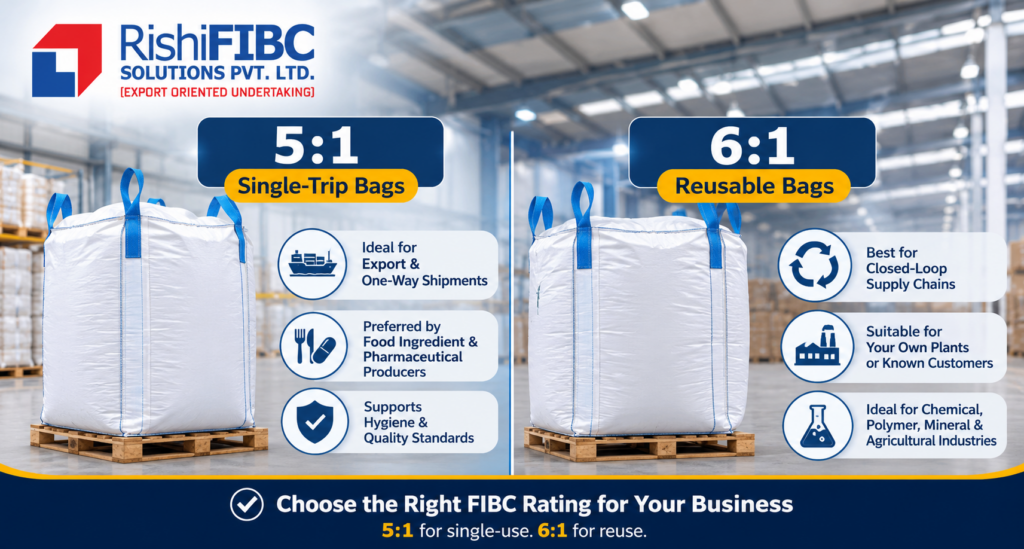 Most buyers do well with 5:1 single-trip bags. The 6:1 option makes sense only when the same bags come back to you.
Export and one-way shipments almost always use 5:1, since the bag will not return. Food ingredient and pharmaceutical producers also choose single-trip bags, often because hygiene rules rule out reuse.
A 6:1 rating suits closed-loop supply chains, where bags travel between your own plants and come back. Chemical, polymer and resin, mineral and agricultural businesses with fixed routes often fit this pattern.
Hazardous products need UN-certified bags, which pass their own testing regime. The UN mark is not a higher safety factor.
How to choose the right SWL for your product?
Start with the weight you need to move and then check that your product will fit in the bag at that weight. Bulk density is the deciding factor here. A light powder will fill the bag well before it gets to 1,000 kg, whereas a dense mineral will reach 1,000 kg in a considerably smaller volume.
Next, look at the jumbo bag material. Fabric weight, loop strength and stitching all change with the SWL and the safety factor. A bag for 2,000 kg of sand needs a different build from one carrying 500 kg of starch. Our guide on bulk density and FIBC selection explains the sizing side in more detail.
Common mistakes that cause bag failure
In our experience as a Jumbo Bag Manufacturer, most failures come from how a bag is used, not how it was made. These are the errors we see most often:
- Overfilling past the SWL because the safety factor seems to leave room.
- Reusing 5:1 bags that were designed for one trip only.
- Lifting a four-loop bag by two loops, which doubles the load on each loop.
- Storing filled bags outdoors for long periods, where sunlight weakens polypropylene.
- Choosing the cheapest bag instead of the one that matches the load and handling.
Our safe handling guidelines for filling and discharge cover the shop floor side of preventing these problems.
Choose the right rating with Rishi FIBC.
SWL and safety factor work together. One tells you how much to fill, and the other tells you how the bag should be used. Getting both right protects your people, your product and your equipment. As one of the experienced jumbo bag manufacturers in India, Rishi FIBC helps buyers match each bag to its job. Share your product, its bulk density and your handling setup with our team, and we will recommend the right SWL and safety factor for your operation.
FAQ
Q1. What is safe working load on an FIBC bag?
Safe working load is the maximum product weight the FIBC bag is designed to carry. It’s printed on the bag label and is the fill limit irrespective of whether the bag is rated 5:1 or 6:1.
Q2. What does 5:1 mean on an FIBC?
A 5:1 rating means the bag withstood five times its safe working load in testing. A 1,000 kg SWL bag rated 5:1 must hold 5,000 kg. It is designed for one single trip.
Q3: Can a 5:1 FIBC bag be reused?
No. A 5:1 bag is designed for one fill and one discharge. Reusing it adds stress the bag was never built for. Choose a 6:1 bag within a controlled reuse programme if you need multiple trips.
Q4: Can I fill a 6:1 bag above its SWL?
No. The safety factor is a reserve for handling forces such as lifting and forklift movement. It never adds fill capacity. Always fill up to the safe working load printed on the label and no further.