

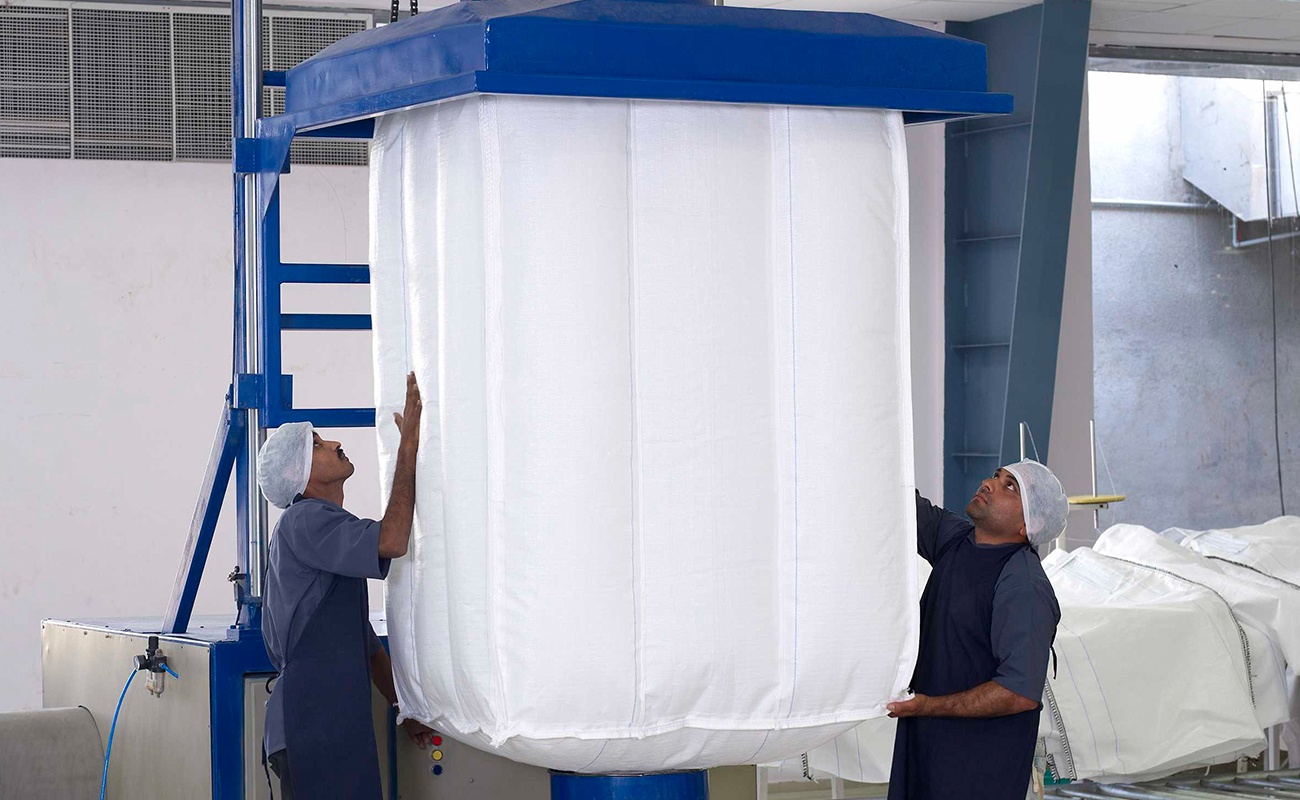



From Stitched to Fused: Fusion Bags Are Redefining Bulk Packaging Standards
Global bulk logistics has never been more demanding. Industries across chemicals, food processing, pharmaceuticals, and agriculture face mounting pressure to move materials faster, cleaner, and with greater traceability than ever before.
Yet for decades, conventional FIBC bags have struggled with the same persistent limitations. Liner misalignment during filling creates contamination risks. Stitched seams allow fine powders to sift through. Separate liner components shift during transport, compromising product integrity. For industries where purity and precision are non-negotiable, these are not minor inconveniences. They are costly operational failures.
The bulk packaging industry needed a fundamentally better solution. That solution is Fusion Bags.
Fusion Bags represent a new generation of industrial bulk packaging, engineered to eliminate the structural weaknesses of conventional designs. They combine strength, hygiene, and operational simplicity into a single, advanced packaging system built for modern supply chains.
What Are Fusion Bags?
Fusion Bags are high-integrity bulk bags that integrate the inner containment structure and outer PP fabric using advanced fusion-bonding technology rather than conventional stitching.
In a standard FIBC bag, the liner is a separate component inserted into the bag body. This creates multiple failure points: the liner can shift, tear at seam edges, or allow product to contact the stitching area. Every sewing hole is a potential pathway for contamination or leakage.
It eliminate this problem entirely. The containment structure is fused directly into the bag, creating a seamless, liner-free, stitch-free product contact zone. There are no sewing holes in the product containment area. There are no loose liner components to misalign. The result is a bulk packaging solution with zero sifting, zero contamination from needle fragments, and significantly improved product purity.
The Technology Behind Fusion Bags
The engineering principle behind it is straightforward yet powerful. Rather than assembling bag components through stitching, Fusion Bags manufacturers use a computer-controlled heat fusion process to bond PP fabric layers together with precision tolerances that conventional stitching cannot match.
This fusion process creates a continuous, sealed product containment zone. The integrated structure distributes load stress more evenly across the bag body, reducing strain concentration at traditional sewn joints.
The result is a bag that delivers improved leak resistance, superior protection for product purity, and a construction that eliminates the material contamination risks inherent in stitched designs. Real-time automated vision control systems monitor the fusion process during production, ensuring every bag meets the same exacting standard.
Key Advantages of Fusion Bags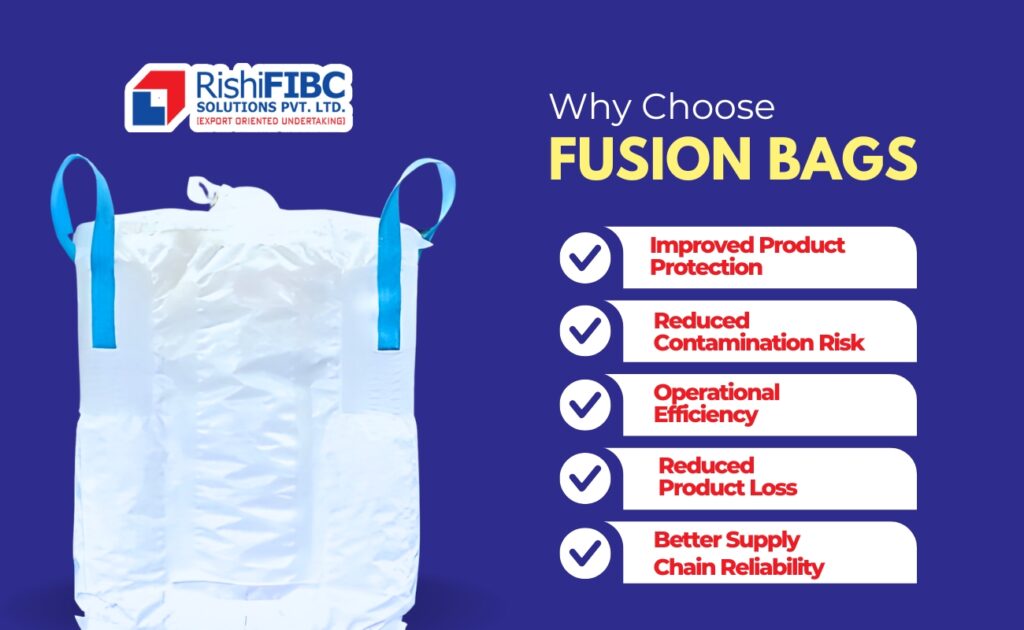
- Improved Product Protection:
Fusion technology creates a seamless containment zone that protects fine powders, granules, and sensitive materials from contamination at every stage of the supply chain. - Reduced Contamination Risk:
With no stitching in the product contact area and no separate liner components, these bags dramatically reduce exposure to dust, external contaminants, and metal fragments. - Operational Efficiency:
Fusion Bags are engineered to work with existing fill and discharge equipment, requiring no changes to current operational infrastructure. This makes adoption straightforward for procurement and logistics teams. - Reduced Product Loss:
Improved containment integrity means less leakage and material waste during filling, transit, and discharge, directly improving cost efficiency across the supply chain. - Better Supply Chain Reliability:
A structurally consistent, computer controlled manufacturing process means every Fusion Bag performs to a verified standard. Non destructive load testing on all bags ensures safety before products leave the facility.
Industry Applications
- Food Processing:
It supports strict hygiene standards by eliminating stitching contamination risks and reducing foreign body concerns in food grade bulk handling. - Chemicals and Specialty Powders:
The seamless containment structure prevents leakage of fine chemical powders and protects product purity during long distance transport. - Pharmaceuticals:
High purity packaging is critical in pharmaceutical bulk handling. These bags eliminate the contamination pathways that make conventional FIBC designs unsuitable for sensitive active ingredients. - Agricultural Commodities:
From seeds to milled grains, they protect agricultural products from moisture ingress and contamination during storage and international shipping. - Advanced Materials:
Industries handling specialty chemicals, battery materials, and advanced powders require packaging that maintains complete integrity across extreme logistics conditions. Fusion Bags deliver that reliability.
Why Choosing the Right Fusion Bags Manufacturers Matters
Not all bulk packaging solutions are equal, and not all manufacturers have the capability to produce Fusion Bags to a consistently high standard.
The fusion bonding process demands precision manufacturing infrastructure, computer-controlled production systems, and rigorous quality testing at every stage. A manufacturer without these capabilities cannot deliver the contamination control and structural integrity that define a true Fusion Bag.
When evaluating Fusion Bags manufacturers, procurement and supply chain professionals should assess manufacturing facility standards, laboratory testing capability, customization options for specific fill and discharge requirements, and compliance with international bulk packaging standards.
Choosing a proven FIBC Bags Manufacturer with demonstrated experience in fusion bag technology ensures that the packaging performs as specified under real logistics conditions.
Rishi FIBC: Engineering the Future of Fusion Bags
Rishi FIBC Fusion Bags are produced using computer-controlled sealing processes and automated vision control systems that verify quality at every stage of production. Non-destructive load testing is conducted on every bag before it leaves the facility, providing documented performance assurance for procurement teams and end users alike.
With decades of experience delivering bulk packaging solutions across food, pharmaceutical, chemical, and agricultural sectors, Rishi FIBC brings the engineering depth and quality infrastructure that Fusion Bag production demands. Their global export capability ensures that supply chains across Asia, Europe, the Middle East, and beyond can access this advanced packaging technology.
For industries where contamination, leakage, and packaging inconsistency carry real operational and financial consequences, Fusion Bags offer a clear path to higher efficiency, stronger product protection, and greater supply chain reliability.
Connect with Rishi FIBC Solutions today to explore how Fusion Bags can be engineered to meet your specific bulk packaging requirements.
FAQ
[/vc_column_text]
Q1: hat are Fusion Bags and how do they differ from standard FIBC bags?
Fusion Bags use heat fusion bonding instead of stitching to create a seamless, liner free bulk bag that eliminates contamination risks and leakage present in conventional FIBC designs.
Q2: Which industries benefit most from using Fusion Bags?
Food processing, pharmaceuticals, chemicals, agriculture, and advanced materials industries benefit most due to Fusion Bags’ superior hygiene, contamination control, and product integrity performance.
Q3: Do Fusion Bags work with existing fill and discharge equipment?
Yes. Fusion Bags are engineered to work with standard fill and discharge equipment, making them easy to adopt without changes to existing operational infrastructure.
Q4: Why is it important to source Fusion Bags from experienced manufacturers?
Experienced Fusion Bags manufacturers use computer controlled production and rigorous quality testing. This ensures consistent structural integrity, contamination control, and compliance with international packaging standards.
Q5: How do Fusion Bags support sustainability goals in packaging?
Fusion Bags require no separate liner, simplifying the recycling process. Fewer material components and reduced product waste also contribute to more sustainable bulk packaging operations.