



Inside Our FIBC Manufacturing Process: Engineering, Testing, and Quality Control
Every jumbo bag that leaves a warehouse carries more than raw material. It carries the trust of a customer who expects that bag to hold, protect, and deliver whatever is inside it, whether that is food grain, pharmaceutical powder, or specialty chemicals. That trust does not happen by chance. It is built through a disciplined FIBC manufacturing process that engineers, tests, and verifies quality at every stage of production. At Rishi FIBC, this philosophy shapes the entire manufacturing journey, turning a simple woven bag into a dependable bulk packaging solution trusted across industries worldwide.
Why the FIBC Manufacturing Process Matters More Than It Seems
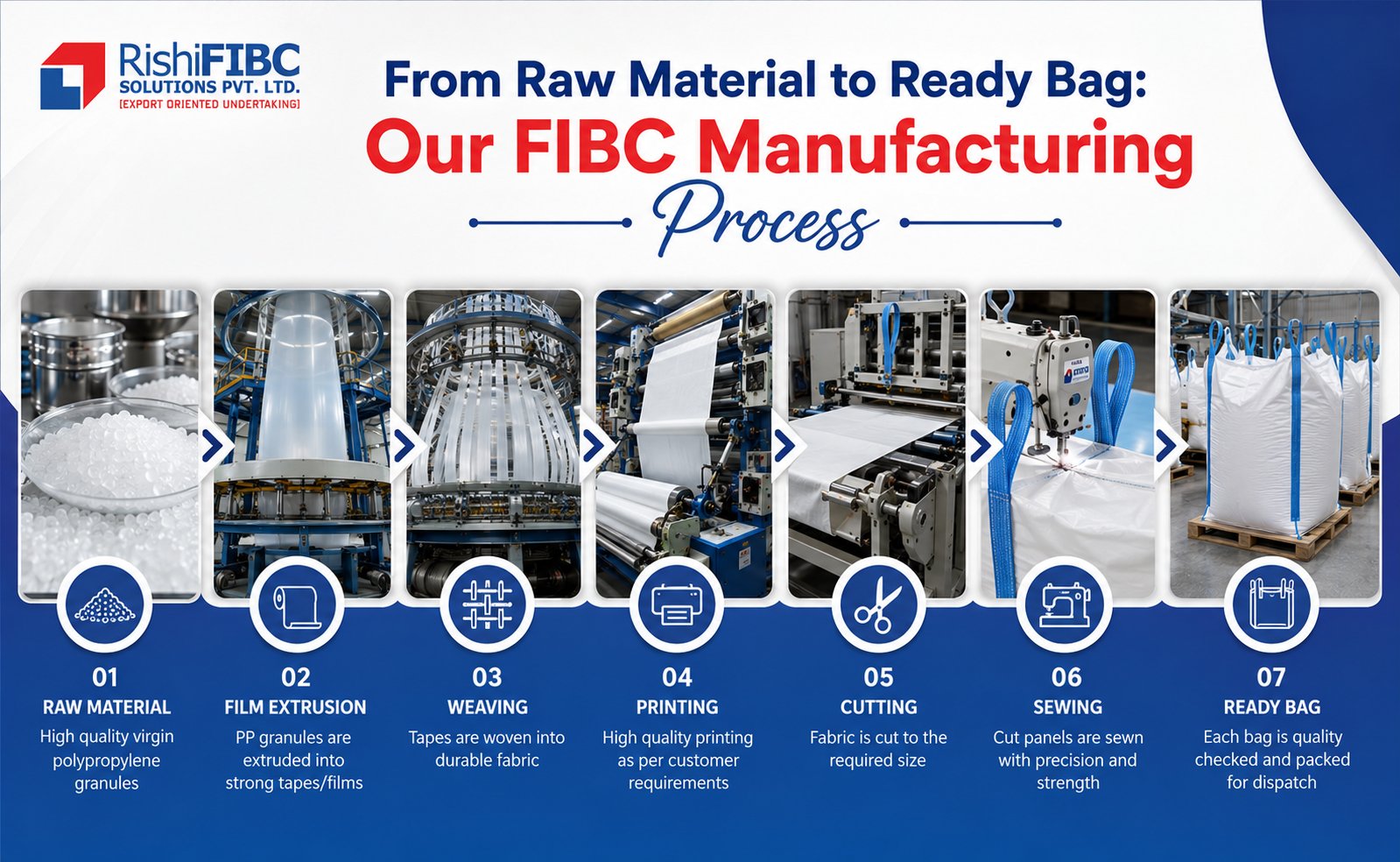
A jumbo bag looks straightforward from the outside, but the FIBC manufacturing process behind it is layered with engineering precision. From selecting the right polypropylene granules to weaving, stitching, coating, and finishing, each step influences how the final bag performs under load, in transit, and in storage. A poorly engineered bag can tear, leak, or contaminate its contents. A well-engineered one protects the product, the supply chain, and the end user’s reputation. This is exactly why the manufacturing process deserves as much attention as the product itself.
Our FIBC Manufacturing Process Built With Purpose
Rishi FIBC’s manufacturing unit in Vadodara, Gujarat spans 250,000 square feet of centrally air-conditioned carpet area, purpose-built to focus on food-grade, pharmaceutical-grade, and specialty chemical packaging. The facility was set up with a clear focus on precision and hygiene from day one, and it has scaled significantly since. Production capacity, which began at 2 million FIBCs annually, grew to 20 million as demand increased and the company expanded into agro-textile products. That growth was never just about volume. It was about proving, batch after batch, that scale and quality could move together.
Engineering FIBC Bags for Real World Performance
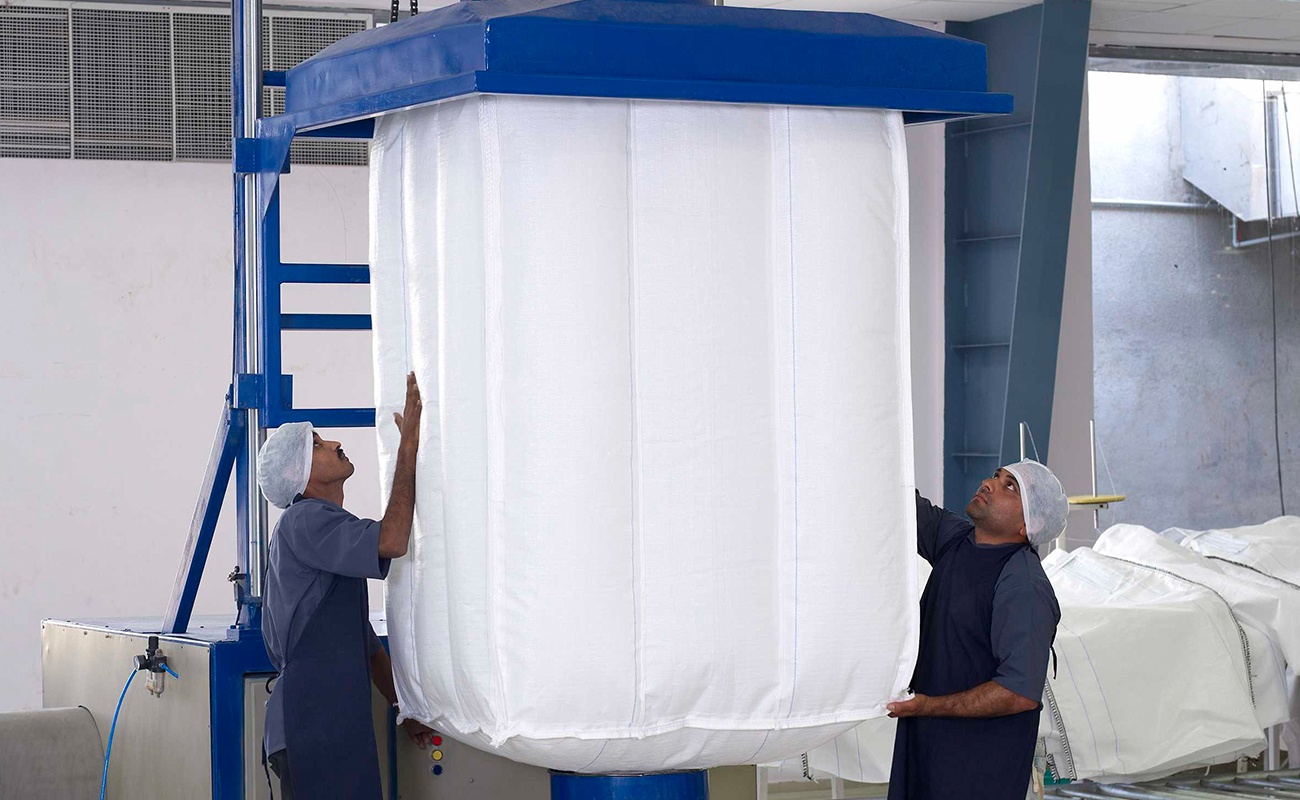
Designing FIBC bulk bags for industries like food, pharma, and chemicals requires accounting for far more than tensile strength alone. Bags must resist UV exposure during outdoor storage, withstand repeated lifting and stacking, and, in many cases, remain free of static charge that could ignite sensitive powders. Engineering teams work through material selection, weave density, baffle design, and lifting loop reinforcement to build bags suited to their exact application. A bag meant for pharmaceutical ingredients is engineered very differently from one meant for construction aggregates, and that distinction begins long before the first roll of fabric is woven.
Hygiene as a Non-Negotiable Standard
For food and pharmaceutical applications, hygiene is not a finishing touch. It is a foundational requirement. Personal and operational hygiene protocols are maintained across the facility to ensure that food-grade FIBC bags remain sanitized and free from contamination. This commitment is reinforced through consistent AIB International ratings since the facility’s inception and adherence to a documented Food Safety Management System. Centralised air conditioning further supports a controlled environment where dust, humidity, and contamination risks are kept to a minimum, which matters enormously when the end product will eventually touch food or medicine.
Testing Capabilities That Leave Nothing to Chance
Every FIBC bag manufactured in FIBC manufacturing process, passes through more than 200 quality control checks from raw material intake to finished product dispatch. Behind these checks sits a sophisticated testing laboratory equipped to evaluate materials and finished bags across multiple parameters, including:
- UV-Vis Spectroscopy
- Oxygen Transmission Rate Testing
- Water Vapor Transmission Rate Testing
- Test rig assessments for Top Lift, Compression, and UN certification tests
- Accelerated UV Weathering Testing
- Universal Testing Machines for mechanical properties
- Breakdown Voltage Testing
- Flex Durability Testing
- Hydrostatic Pressure Testing
- Carbon Content Testing
- Coefficient of Friction Testing
This range of testing ensures that every FIBC bag can withstand real world handling, environmental exposure, and the specific demands of its intended cargo, whether that means resisting moisture ingress or managing static discharge safely.
Why Quality Control Directly Benefits the End User
For a buyer sourcing bulk packaging, quality control is not a back office process. It is the difference between a shipment that arrives intact and one that results in product loss, contamination, or safety incidents. Rigorous testing and hygiene protocols translate into fewer failures in the field, longer shelf stability for sensitive contents, and compliance with international safety standards that many industries are legally required to meet. When a manufacturer treats quality control as central rather than optional, the end user gains predictability, safety, and peace of mind with every single bag.
Sustainability Woven Into the Process
Quality manufacturing today also means responsible manufacturing. Since the start of its operations, the company has focused on recycling the waste generated during production, redirecting it to industries that use it in place of virgin material. This approach reduces environmental impact without compromising the performance standards that food, pharma, and chemical industries rely on.
Sustainability Woven Into the Process
Quality manufacturing today also means responsible manufacturing. Since the start of its operations, the company has focused on recycling the waste generated during production, redirecting it to industries that use it in place of virgin material. This approach reduces environmental impact without compromising the performance standards that food, pharma, and chemical industries rely on.
Choosing a Manufacturer That Gets the Details Right
Bulk packaging is easy to overlook until something goes wrong. Choosing a manufacturer that treats engineering, hygiene, and testing as inseparable parts of the same process is what protects your product, your customers, and your reputation. Rishi FIBC brings together a purpose built facility, disciplined manufacturing standards, and an extensive testing framework to deliver FIBC bags that perform when it matters most. If your business depends on dependable bulk packaging, it is worth considering Rishi FIBC for your next requirement.
FAQ
Q1: <b> What is the FIBC manufacturing process?</b>
It involves selecting suitable raw material, weaving fabric, stitching, coating, and finishing bags under controlled conditions, followed by extensive testing to ensure the finished FIBC bags meet strength, safety, and hygiene requirements for their intended use.
Q2: Why is quality control important in FIBC bags?
Quality control ensures every bag can safely carry its intended load without tearing, leaking, or contaminating contents. It protects the end user from product loss, safety hazards, and compliance issues during storage or transport.
Q3: What testing methods are used for FIBC bulk bags?
Testing includes UV weathering, hydrostatic pressure, breakdown voltage, flex durability, coefficient of friction, and mechanical strength testing, along with top lift and compression tests, ensuring bags perform reliably under real world conditions.
Q4: Are FIBC bags safe for food and pharmaceutical use?
Yes, when manufactured under strict hygiene protocols and Food Safety Management Systems, FIBC bags are sanitized and free from contamination, making them suitable for sensitive food grade and pharmaceutical grade applications.
Q5: How does choosing the right FIBC bags manufacturer help my business?
A manufacturer with strong engineering and testing standards reduces the risk of packaging failure, protects your product’s integrity, and ensures consistent quality across every shipment, saving cost and reputation in the long run.