



Fusion Bags Explained: Zero Siftage Packaging for Fine Powders
Not every product that moves through a supply chain behaves the same way inside a jumbo bag. Fine powders in particular create a packaging challenge that coarser materials rarely face, and the industry’s answer to that challenge is the fusion bulk bag. Before understanding why this bag exists, it helps to understand the product it was designed to protect.
What Exactly Is a Fine Powder and Why Does It Matter for Fusion Bulk Bag?
Fine powder refers to material composed of extremely small particles, often finer than table salt or even flour, with particle sizes so tiny that they behave almost like a liquid when disturbed. Industries such as pharmaceuticals, food processing, chemicals, cement, minerals, and specialty additives regularly produce fine powders, ranging from active pharmaceutical ingredients to milk powder, calcium carbonate, silica, and pigment compounds. These materials are typically received by manufacturers in downstream industries such as food formulation units, drug manufacturing plants, paint and coating companies, and construction material producers, all of whom depend on receiving the exact quantity they paid for, with zero loss along the way.
The problem is that fine powders find their way through the smallest of gaps. A pinhole, a needle mark, or a stitching perforation that would be harmless for granules or flakes becomes an escape route for fine powder. This phenomenon, known in the industry as sifting or siftage, results in product loss, workplace contamination, and in sensitive industries like pharma and food, serious safety and compliance concerns. This is precisely why handling fine powder requires a bag engineered differently from a standard jumbo bag, and this is where fusion bags come into the picture.
What Is a Fusion Bulk Bag?
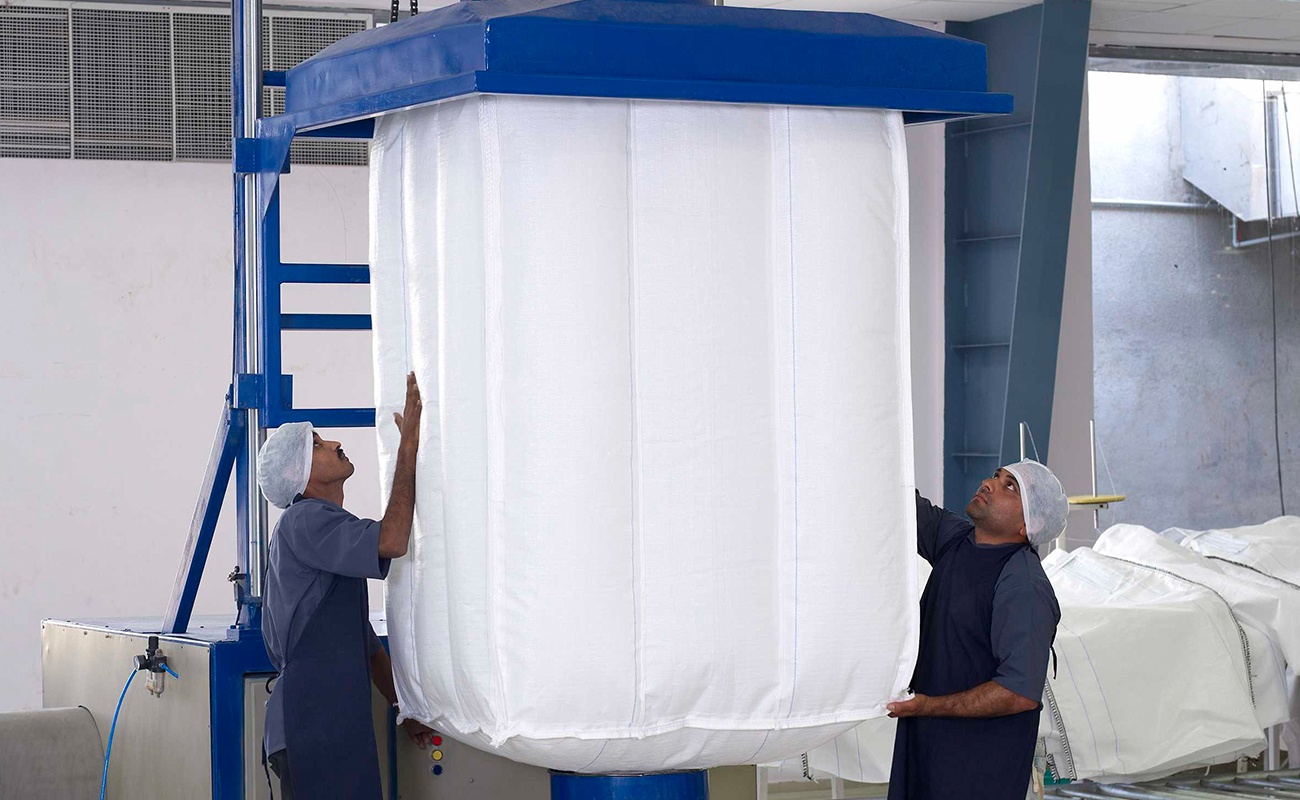
A fusion bulk bag is a next-generation FIBC built by fusing layers of PP fabric together rather than stitching them, eliminating the needle holes that traditional sewing leaves in the product containment area. In simple terms, it replaces the age-old method of sewing panels with a computer-controlled sealing process, giving the finished bag a smooth, hole-free interior surface. Because there are no needle perforations and no seams inside the bag where powder can escape, fusion bags are widely recognised as offering zero siftage, meaning the fine powder inside stays exactly where it should, from filling to discharge.
Fusion Bags Versus Standard Unlined Bag
A standard unlined bag depends entirely on stitching to hold its shape and structure. While this works well for granular or lump material, stitching naturally creates small perforations along every seam. For fine powders, these perforations become weak points where product can seep out during transport, stacking, or vibration. A fusion bag eliminates this vulnerability altogether, as there is no sewing in the product containment area. Compared to a standard lined bag, which relies on an internal liner to compensate for stitching gaps, fusion bags eliminate the need for a liner entirely, since the fused fabric itself is already contamination-resistant. Fewer components mean fewer failure points, simpler recycling, and a cleaner overall packaging solution.
Hygiene as a Non-Negotiable Standard
For food and pharmaceutical applications, hygiene is not a finishing touch. It is a foundational requirement. Personal and operational hygiene protocols are maintained across the facility to ensure that food-grade FIBC bags remain sanitized and free from contamination. This commitment is reinforced through consistent AIB International ratings since the facility’s inception and adherence to a documented Food Safety Management System. Centralised air conditioning further supports a controlled environment where dust, humidity, and contamination risks are kept to a minimum, which matters enormously when the end product will eventually touch food or medicine.
Why Fusion Bag Technology Is a Genuine Industry Upgrade?
Fusion bag technology offers several practical advantages that go beyond simply preventing leakage. Because there is no sewing and no liner, there is virtually no risk of needle fragments or foreign material entering the product, a critical requirement for pharmaceutical and food-grade packaging. The manufacturing process itself is computer-monitored, with automated vision control systems checking every bag for consistency, ensuring the tested design is the exact design that reaches the customer every single time.
Each fusion bag also undergoes a non-destructive load test on the loop patch and body fabric, mimicking real-world lifting stress before the bag ever leaves the facility. Importantly, fusion bags are designed to work with existing fill and discharge equipment, so businesses do not need to overhaul their current setup to benefit from this technology.
Key Operational Advantages of Advanced Fusion Bags
Partnering with an experienced fusion bag supplier brings deep structural reliability and distinct advantages to your operational workflows:
- True Zero Siftage: The continuous integrated barrier creates an absolute seal that stops even submicron particles from escaping through fabric seams.
- Zero Liner Blowouts: Traditional loose liners can accidentally pull out or tear during rapid discharge blocking machinery. Fusion technology entirely eliminates this risk.
- Uncompromising Product Purity: The secure seal blocks external moisture, dust, and contaminants from entering, keeping high-value powders perfectly pure.
- Enhanced Load Stability: Because the integrated liner fills out perfectly into every corner, the filled bag maintains a highly symmetrical square profile optimizing shipping container space.
Who Benefits Most from Choosing a Fusion Bag Supplier
Any business packaging fine powders, from pharmaceutical manufacturers handling active ingredients to food companies packing milk powder or starch, and chemical producers dealing with pigments or silica, stands to gain from working with an experienced fusion bag supplier. The benefits extend beyond zero siftage. Reduced product loss directly protects profit margins, cleaner containment supports regulatory compliance, and simplified recycling, since there is no liner to separate out, supports sustainability goals as well. For businesses where even a small percentage of product loss can translate into a significant financial impact at high volumes, fusion bags offer a measurable and repeatable advantage.
Choosing the Right Partner for Fusion Bulk Bags
Not every FIBC manufacturer has the technical capability or precision equipment required to produce genuine fusion bags at scale. It takes computer-controlled sealing technology, rigorous testing protocols, and a manufacturing culture built around consistency to get this right, batch after batch. Rishi FIBC brings this exact combination of engineering capability and quality discipline to fine powder packaging, offering fusion bulk bags designed to eliminate siftage, protect product integrity, and support cleaner, more efficient operations. If your business handles fine powders and cannot afford product loss or contamination, it is worth exploring how Rishi FIBC’s fusion bag technology can benefit your packaging line.
FAQ
Q1: What makes fine powder different from other bulk materials?
Fine powder consists of extremely small particles that flow almost like liquid, allowing it to escape through tiny gaps such as stitching holes, which coarser granular or lump materials generally cannot pass through.
Q2: How does a fusion bag prevent siftage?
Fusion bags are assembled by fusing PP fabric layers instead of stitching them, eliminating needle holes in the product containment area, which removes the escape points where fine powder would otherwise leak out.
Q3: Do fusion bags require an internal liner?
No, fusion bags typically do not require a liner. Since the fabric is fused and free of stitching perforations, it already offers strong contamination and moisture resistance without an added liner layer.
Q4: Which industries benefit most from fusion bulk bags?
Pharmaceutical, food processing, and chemical industries handling fine powders such as active ingredients, milk powder, starch, and pigments benefit most, since these sectors cannot afford product loss or contamination risks.
Q5: Can fusion bags be used with existing filling equipment?
Yes, fusion bags are designed to work with standard fill and discharge equipment already in use, allowing businesses to adopt the technology without changing their current operational setup.