



How to Choose the Right Jumbo Bag Size: Bulk Density and Fill Weight
A bag that fills to the brim at 600 kg when you’d planned on 1,000 kg is a very expensive surprise. Similarly, a bag that’s half full and hangs over the side of the pallet costs you money. Both of those problems come down to the wrong jumbo bag size. Fortunately, the solution is far simpler than most people realise. You just need two figures, your fill weight and your product’s bulk density, and a few minutes with a calculator.
What decides the right jumbo bag size?
The right jumbo bag size depends on how much product you want in each bag and how much space that product takes up. In other words, weight and volume have to match the bag, and the weight must stay within its safe working load.
Two products with the same fill weight can need very different bags. For example, a tonne of sand and a tonne of plastic granules weigh the same, yet one needs nearly three times the space of the other. That is why bulk density matters more than the product name.
How do you calculate the size you need?
First, divide your fill weight by your bulk density to get the volume you need. Then add approximately 10% for bulging and settling. Finally, pick the bag size that covers that volume.
Here’s how it works for a dense product. Sand weighs about 1,500 kg/m³. So for 1,000 kg, you need about 0.67 m³, or roughly 0.73 m³ with the margin. As a result, a 90 x 90 x 90 cm bag, which gives about 0.73 m³, will fit.
Now take a light product. A powder at about 500 kg/m³ needs about 1 m³ for just 500 kg. With the margin, that rises to about 1.1 m³, so a 95 x 95 x 125 cm bag suits it better.
Did you know? A tonne of sand fits in about 0.67 m³. In contrast, a tonne of plastic granules needs about 1.8 m³, so the same weight can call for a bag almost three times larger.
What are the standard jumbo bag dimensions?
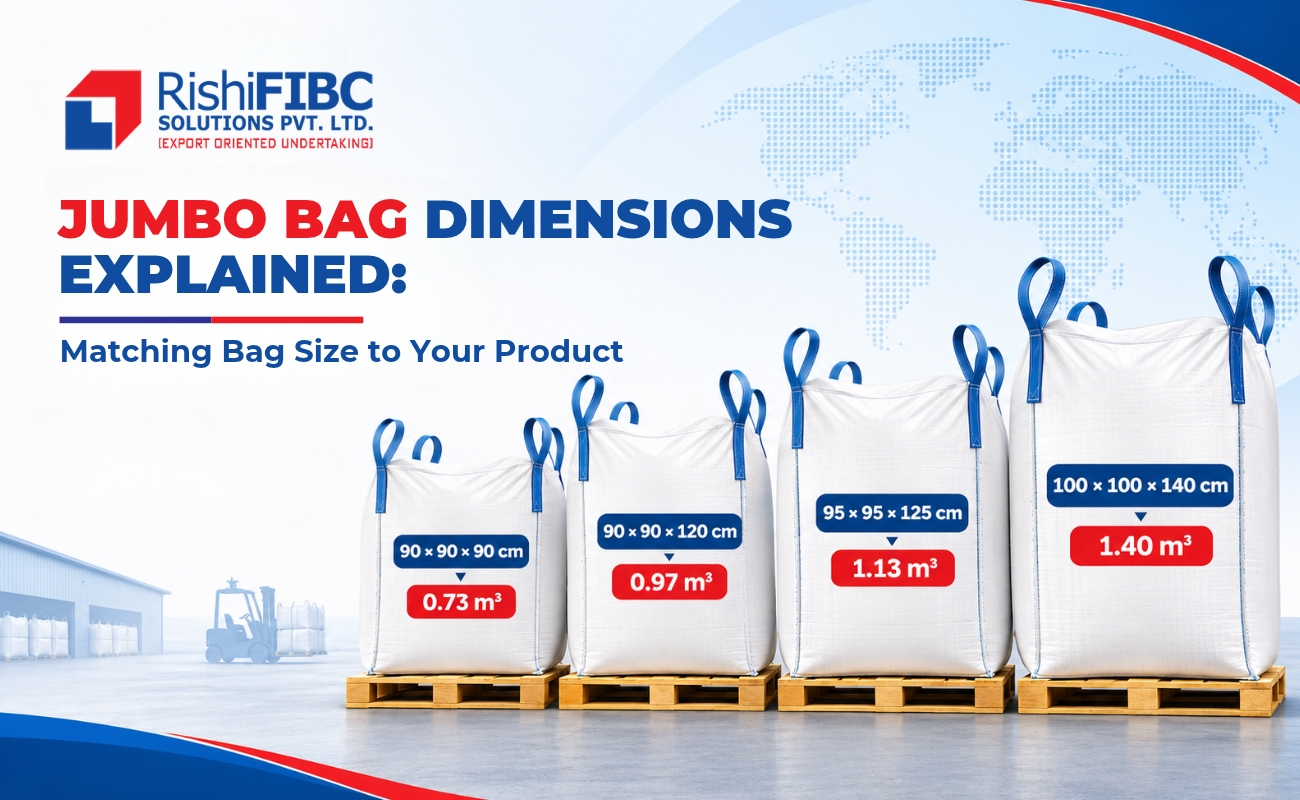
Most standard jumbo bag dimensions use a square base of 90 to 100 cm, with heights from 90 to 140 cm. Together, these sizes cover the majority of loads between 500 kg and 1,200 kg.
However, every product settles differently, so treat these as starting points. Rishi FIBC makes FIBC Bags with SWL from 500 kg to 2,000 kg, and also makes custom sizes beyond these common ones.
| Size (cm) | Approximate volume | Suits products like | Typical fill range |
|---|---|---|---|
| 90 x 90 x 90 | 0.73 m³ | Sand, gravel, dense minerals | About 1,000 kg |
| 90 x 90 x 120 | 0.97 m³ | Cement, fertilisers | 1,000 to 1,200 kg |
| 95 x 95 x 125 | 1.13 m³ | Sugar, grains, granules | About 800 kg |
| 100 x 100 x 140 | 1.40 m³ | Flour, plastic granules, light powders | About 700 kg |
How does bulk density change the bag you need?
Bulk density tells you how much one cubic metre of your product weighs. Higher density means a smaller bag for the same weight. On the other hand, lower density means a taller or wider one.
Approximate figures help with early planning. For instance, cement sits around 1,400 kg/m³, sugar around 800 kg/m³ and flour around 550 kg/m³. In our experience, though, the same product can vary by 10% or more between suppliers and batches. Therefore, always test your own material before you finalise a size. Our guide on bulk density covers how to measure it.
Will the bag fit your pallet, filling station and container?
A bag that fits your product can still fail your process. For this reason, check the footprint against your pallet, the height against your filling station and the shape against your container.
A filled bag should sit within the pallet edges, never hanging over them. Otherwise, overhang strains the base fabric and makes forklift handling unsafe. Height also matters at the filling station, since the spout must reach the filling head. For container shipments, round bags bulge and waste space between them. In comparison, a baffle bag holds a square shape and packs more neatly. Above all, the number of bags per container depends on bag size, bag type and product, so plan it with your supplier.
Which bag material and design should you pick?
Choose the bag material and design to suit your product’s weight, flow and protection needs. After all, size and construction go together. Jumbo bag material usually means woven polypropylene, with fabric weight chosen to match the SWL. In addition, fine or moisture sensitive powders often need an inner liner. Design changes how the bag behaves too. For example, U panel and four panel bags keep their shape well, while baffle designs give the squarest fill for storage and transport. Whatever design you choose, it should pass ISO 21898 testing.
Get the right size from Rishi FIBC
In short, the right jumbo bag size saves money on every shipment. You fill each bag fully, stack it safely and use your container space well. As one of the experienced jumbo bags manufacturers in India, Rishi FIBC helps buyers size fibc jumbo bags around real products instead of guesswork. So share your product, its bulk density, your target fill weight, and your filling and transport setup with our team. We will then recommend the size and construction that fits.
FAQ
Q1. What size jumbo bag do I need for 1 ton?
For dense materials like sand, a 90 x 90 x 90 cm bag of about 0.73 m³ holds 1 ton. However, lighter products need much more space, so calculate using your product’s bulk density before choosing a size.
Q2. What is the standard jumbo bag size?
Most standard jumbo bags have a square base of 90 to 100 cm and a height between 90 and 140 cm. These sizes suit the majority of loads between 500 kg and 1,200 kg.
Q3: How do I calculate bulk bag size?
First, divide your fill weight in kilograms by your bulk density in kg/m³. This gives the volume you need. Then add about 10% for bulging and settling, and choose the bag size that matches that volume.
Q4: How does bulk density affect jumbo bag size?
Bulk density shows how much one cubic metre of product weighs. Dense products need smaller bags for the same weight. In contrast, light powders and granules need taller or wider bags to hold the same load.
Q5: How much can a jumbo bag hold?
Capacity depends on both volume and safe working load. For example, common jumbo bags hold between 0.7 m³ and 1.4 m³ and carry 500 kg to 2,000 kg. Never fill beyond the SWL on the label..